Water Ways
A solo puzzle game about building aqueducts. You place and rotate blocks to guide a stream of balls, without one strict solution.
- My role
- Level design, shaders, models, playtesting, logo, trailer
- Setup
- Solo
- Tools
- Unity, Blender, Miro
Brief & goal
Step into Water Ways, a puzzle game where you have to overcome levels by using your imagination. You are the builder, solving puzzles by crafting unique structures. As a builder you’ll have access to multiple blocks, which you can place wherever you want.
I wanted a puzzle game that allowed for creativity: the player builds, and does not have to conform to one strict solution.
Design reasoning
I wanted to take a very simple concept — building aqueducts — and expand on it, instead of locking the player to one strict solution.
That only works if you can read the space. Depth is easy to misjudge, so the camera had to rotate and move freely in 3D.
Then there was the problem of not wanting the player to win by accident. If a few balls reached the end they could win, but their puzzle might not actually work. To solve that I created a counting system: the player needs at least a set number of balls to reach the goal in a certain time frame. If one ball reaches the end, it ticks down again after five seconds, so the player can only win if there is a steady stream of balls getting to the end. These are two small examples of the design process and playtesting.
Role & collaborators
Solo project. I did the level design, shaders, models, playtesting, logo art and the trailer.
Tools
Process
I prototyped the main mechanic first and made sure it played well. Building aqueducts is the core, but camera movement was a big focus, because depth perception is crucial. I tested rotating the camera and moving it in 3D space.
Level design stayed on that building idea, with small extras for interest and a skill buildup that stayed in scope: a no-build zone, a cannon, an unlock button.
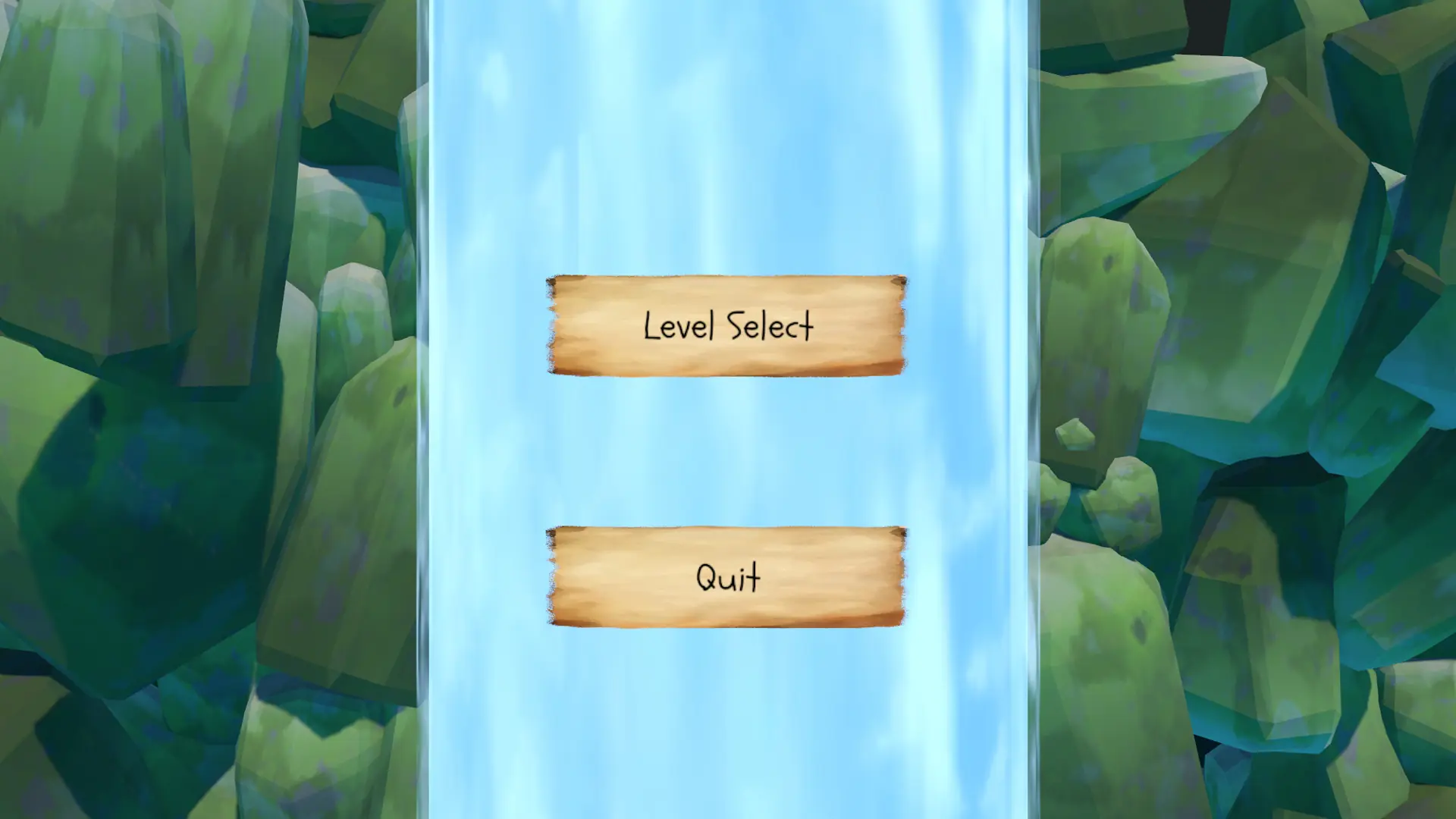
Practical work included a clear tutorial with gifs and a start screen. Models and grass shaders came in to make the game look better.
- 01Level 1 — camera movement, plus placing and moving blocks
- 02Level 2 — block rotation
- 03Level 3 — combine placement with rotation
- 04Level 4 — button: balls hit the button first, then the goal
- 05Level 5 — the button must be hit continuously
- 06Level 6 — cannon, and a simple no-build zone
- 07Level 7 — denser grid of flying rocks, plus the cannon
- 08Level 8 — the same idea, with a no-build zone as extra challenge
- 09Level 9 — longer run: momentum and long-term thinking
- 10Level 10 — hit four holes at the same time
What worked
- The aqueduct-building loop held up, and players stayed engaged with the puzzles.
- Small varieties made interesting puzzles, with a skill buildup that kept challenging the player in a gradual way.
What could have gone better
A lot of the levels still have a prototype feel and read as unfinished. That was mainly a time constraint, so polish sat lower on the list, but I would have liked to pull everything into the nature feel I was after.
The game is called Water Ways: there is grass, rocks, a waterfall. In gameplay I would have liked to — or will later — put more work into the environment: trees, canyons, mountains, mechanics tied to that nature (a weighted wooden plate that opens a wood-built wall, instead of a machinery-like button), and finished models instead of ProBuilder blocks.